
US AID: LESTARI
Bottom-up Development for Inclusion and Sustainability
LESTARI is a project set up by USAID’s Indonesia Forest and Climate Support (IFACS)⁶⁰ and 11 key consultants.
Aim: To support the Indonesian government in reducing greenhouses gas (GHG) emissions and conserving biodiversity in carbon rich and biologically significant forest and mangrove ecosystems⁶⁰ .
Tetra Tech ARD is the key consultant who provides practical and sustainable international development services⁶¹.
Tetra Tech through LESTARI applies a landscape-approach that combines conservation objectives and low emission development strategies⁶² to harmonise development and conservation objectives.
What is LESTARI?
40% decrease of CO2 equivalent emissions.
Claimed 8 million ha of forest and put them under improvement management.
Overall helping Indonesia decrease greenhouse gas (GHG) emissions and increasing forest and wildlife conservations.
Results after 6 years of establishment ⁶³
Environmental assessments
Regional development plans
Spatial plans
Conservation area management plans,
Forest Management Unit plans
Village Development Plans
LESTARI conducts⁶⁴ :
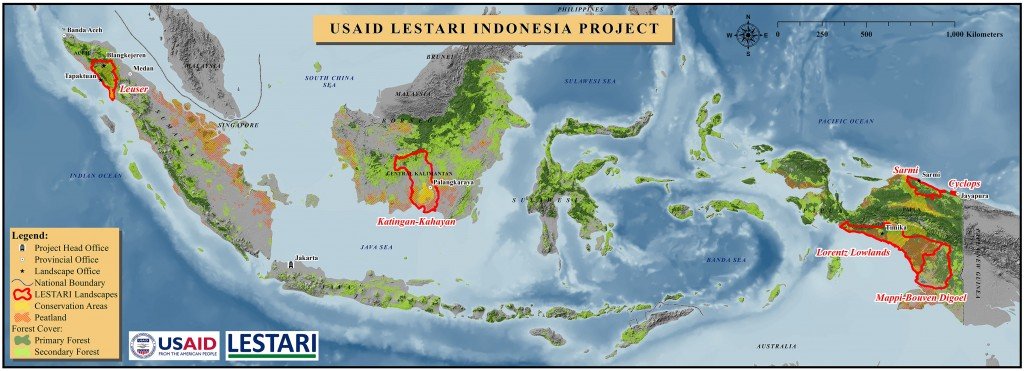
Landscapes supported by LESTARI ⁶⁵
LESTARI’s Strategy
-
Strategic Approach:
Awareness and Advocacy
Environmental Governance
Supports effective forest and land use governance practices while building strong constituencies that can advocate for their communities’ rights and interests.
-
Strategic Approach:
Co-management
Protected Area Management
LESTARI defines the term critical area as an area identified for conservation because of its high conservation value or high carbon value.
Done at 3 levels:
Increasing capacity of the National Parks staff responsible for their conservation area management with partners WWF and WCS.
Piloting innovative financing for PAs
Improving co-management adjacent to the PA and in critical areas.
-
Strategic Approach:
Green Enterprises
Private Sector BMPs
PES and REDD+ Innovative Finance
Support alternative livelihoods while reducing pressure on forest resources.
Engages with timber concessions, palm oil plantations, and other private sector actors operating in its landscapes to apply BMPs focused on improving efficiency and acquiring sustainability certification.
-
1. Provincial Government Developmental plans (RPJMD)
2. Provincial Government Spatial Plans
3. Forest Management Unit Plans (RPHJP)
-
Tetra Tech ARD
Tetra Tech’s offers climate change services:Conducts scientific and policy assessments
Performing the full suite of greenhouse gas (GHG) emissions
Provides climate risk advanced data analytics to develop and implement effective adaptation and mitigation solutions.
Winrock International
Non-profit organisation
Recognised leader in US and international development.Gathers environment data
Supports implementation of Sustainibility Screening Tool for provincial and district-level licensing and permitting.
PT South Pole Indonesia
Environmental Innovation.
They are focused on identifying and developing high-quality carbon credits for landscape-level conservation.Support implementation of PES (selling of carbon credits) schemes in the landscapes.
-
Local National Parks in 6 landscapes.
World Wildlife Fund Indonesia and Wildlife Conservation Society
Assists to manage the 6 Landscapes.Improve the management effectiveness of National Parks.
Implemented SMART Patrol.
-
Michigan State University
Establishes education linkages with local universities to develop and teach the villages.INFIS-Mongabay Indonesia
Conservation News Web PortalProduce and disseminate awareness-raising products covering forestry and biodiversity issues within LESTARI landscapes online.
Lembaga Awali Amanat & Tropical Forests Foundation
Conducts “Reduced Impact Logging (RIL-C)” for timber concession partners in Katingan-Kahayan and Sarmi Landscapes.
-
FIELD
Facilitates the villages in developing co-management agreements in Aceh and Central Kalimantan.
Yayasan Sahabat Cipta (Swiss Contact-Indonesia)
Supports livelihood expansion and co-management in Aceh.Blue Forests
Project Developer of Land Management and Conservation Projects. Support mangrove co-management activities in Lorentz Lowlands.
Agencies⁶⁷
Thematic Activites⁶⁶:
VILLAGE BASED PROGRAMMES

Spatial Monitoring and Reporting Tool “Resort-Based Management” (SMART-RBM) ⁶⁹
Led by Ministry of Environment and Forestry.
The LESTARI project trained and facilitated establishment of community forest patrol groups in the 6 landscapes.
Peer to peer learning among community groups (one patrol group can teach to the next)
Conducted biodiversity monitoring, threat mitigation and protected area boundary mapping and analysis.

Community Forest Patrols are applied in 4 landscapes in Papua. The Kampung Lestari initiative taught communities to be stewards of their local environments, encouraging mutual respect between the government and the villages. Villagers are now more likely to report illegal activities to the authorities.
Reported to the Papua Forest Agency and Lorentz National Park Authority.
Train them on natural resource management and monitor for potential threats.
Kampung Lestari ⁷⁰

A process to allow stakeholders to be involved in all stages of forest assessment. It is in line with Community Forest Protection (Kelompok Jaga Hutan - KJH)
Discusses and provides forest protection efforts that are in line with local customary values.
KJH patrols traditional forest areas and monitors natural resource and forest use.
KJH can turn into MMP where the forest management agencies have priorities on conservation efforts.
Participatory Monitoring and Evaluation (PME) ⁷¹

Governed by Forestry Ministerial Regulation No.56/2014)
Receives direct support from government agencies for patrol equipment: GPS, cameras, uniforms.
MMP are also located for protection of mangroves and culturally significant forests to assist National Resource Conservation Agency (BBKSDA) Papua from encroachment threats.
Forest Guard Community Partners (Masyarakat Mitra Polhut - MMP) ⁷²
Village Level Engagement⁶⁸
Village level engagement is a crucial part of this approach because:
It contributes to bottom-up development for inclusion and sustainability
Villages have overlapping jurisdictions with National Parks and Forest Management Unit areas
Villages now control significant annual budgets, which represent a large untapped resource for forest conservation